


Where It All Began: Basile’s Swine Roots (1963–1966)
In 1963, a group of local swine producers came together to form the Southwest Louisiana Swine Producers Association, with the goal of organizing and promoting feeder pig sales for themselves and other area farmers. Their first official sale took place in November 1964 at the Basile Town Park’s Recreational Building—what locals now call the Pig Barn.
The success of these early sales was immediate. By 1967, the association had secured a government grant to construct a larger, more permanent feeder pig sale barn at the west end of Stagg Avenue, just outside Basile’s town limits near Bayou Nezpique. The small road leading from the barn to Highway 190 became known as Feeder Pig Lane.
Sales continued there until 1974, when the market demand for pigs dropped dramatically, forcing the closure of the barn and the end of feeder pig sales in the region.

Amidst the early success of the swine producers, a new idea was born — the Louisiana Swine Festival. On September 12, 1966, the festival was officially incorporated as a nonprofit organization in the State of Louisiana, sworn before C. L. Hester, Jr., Notary Public.
According to the Articles of Incorporation, the festival’s purpose was to promote Louisiana’s agricultural prosperity, especially through the swine industry. The mission included increasing market demand for Louisiana-raised swine, encouraging meat-packing industries to establish locally, and promoting goodwill and tourism through an annual celebration known as the Louisiana Swine Festival.
To finance the first event, the founders sold membership certificates at $2 each, aiming for 1,000 members. The festival was managed by 53 directors chosen from those certificate holders.
The original officers were:
Oscar Reed, President
Vories Moreau, 1st Vice President
Eldon Manuel, 2nd Vice President
Dr. Bobby Deshotel, 3rd Vice President
Donald J. Miller, 4th Vice President
Joyce Fruge, Secretary
JoElla Deshotel, Treasurer
The Birth of the Festival
(1966–1967)

Even as the swine industry in Basile faded, the Louisiana Swine Festival continued to thrive as a celebration of local culture and pride. In its early years, the King of the Festival was chosen from among the pig farmers. After the industry’s decline, community leaders, cultural icons, and public figures began to receive the honor instead.
The festival has been held every year since 1966, with only two exceptions:
1974, when the town was disrupted due to the installation of a new sewer system.
2020, when the COVID-19 pandemic forced its cancellation.
Though the hog sales ended, Basile’s connection to its agricultural roots remains strong through the festival’s music, food, and family-centered traditions.
From Industry to Culture (1967–1974 and beyond)
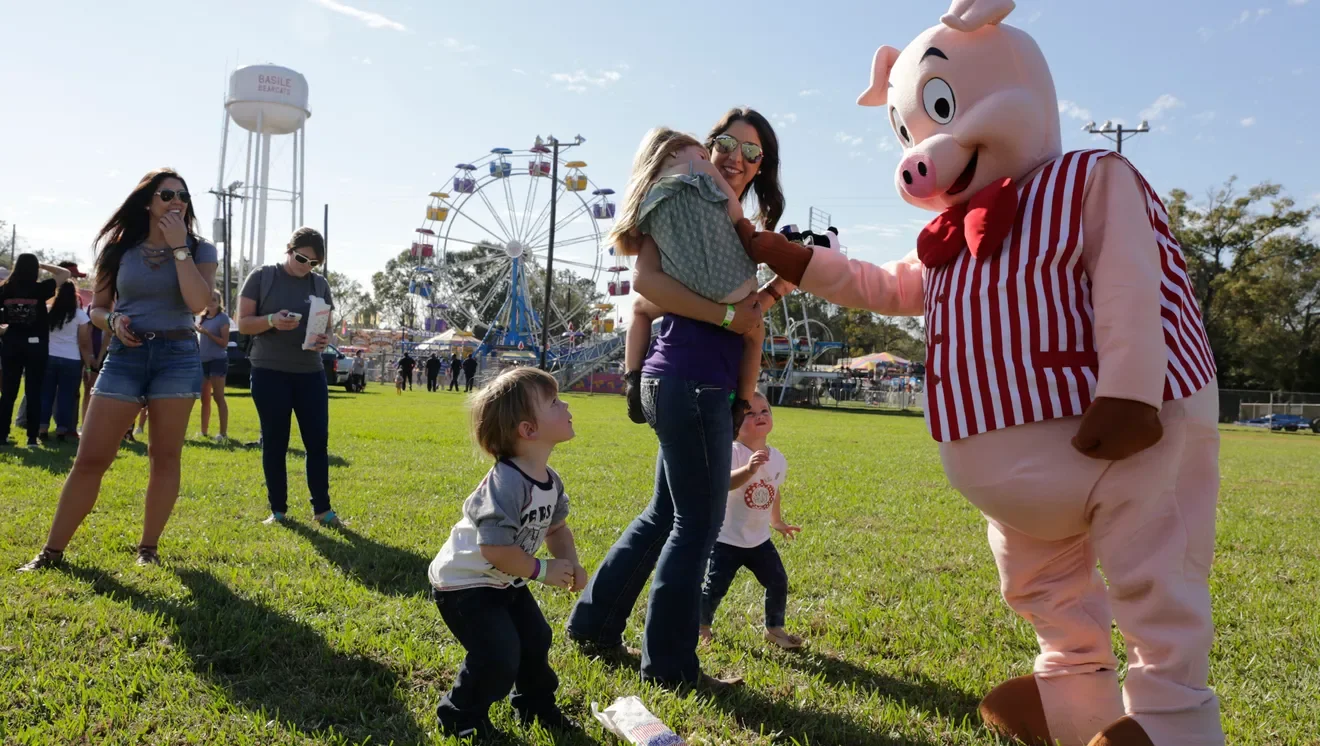
The Louisiana Swine Festival is now a proud member of the Louisiana Association of Fairs and Festivals (LAFF) and continues to celebrate the heritage of both farming and Cajun culture.
When the festival began, only a few other celebrations existed across southwest Louisiana. In its early years, Swine Festival Queens even competed in the Miss Louisiana Pageant, before the creation of the LAFF’s Queen of Queens competition.
Initially, the festival featured only two pageants:
Miss Louisiana Swine Festival (for high school and college girls)
King and Queen Petunia (for children)
By the 1980s, additional categories were added for babies, toddlers, and younger girls, along with the creation of a Ms. Swine Festival division for adult women.
All pageants are held in a single day, typically about two weeks before the first weekend in November, when the festival itself takes place.
Over the years, what began as a small event to promote local pig farmers has grown into a beloved Louisiana tradition — celebrating not just swine, but the spirit, pride, and community of Basile and its people.